


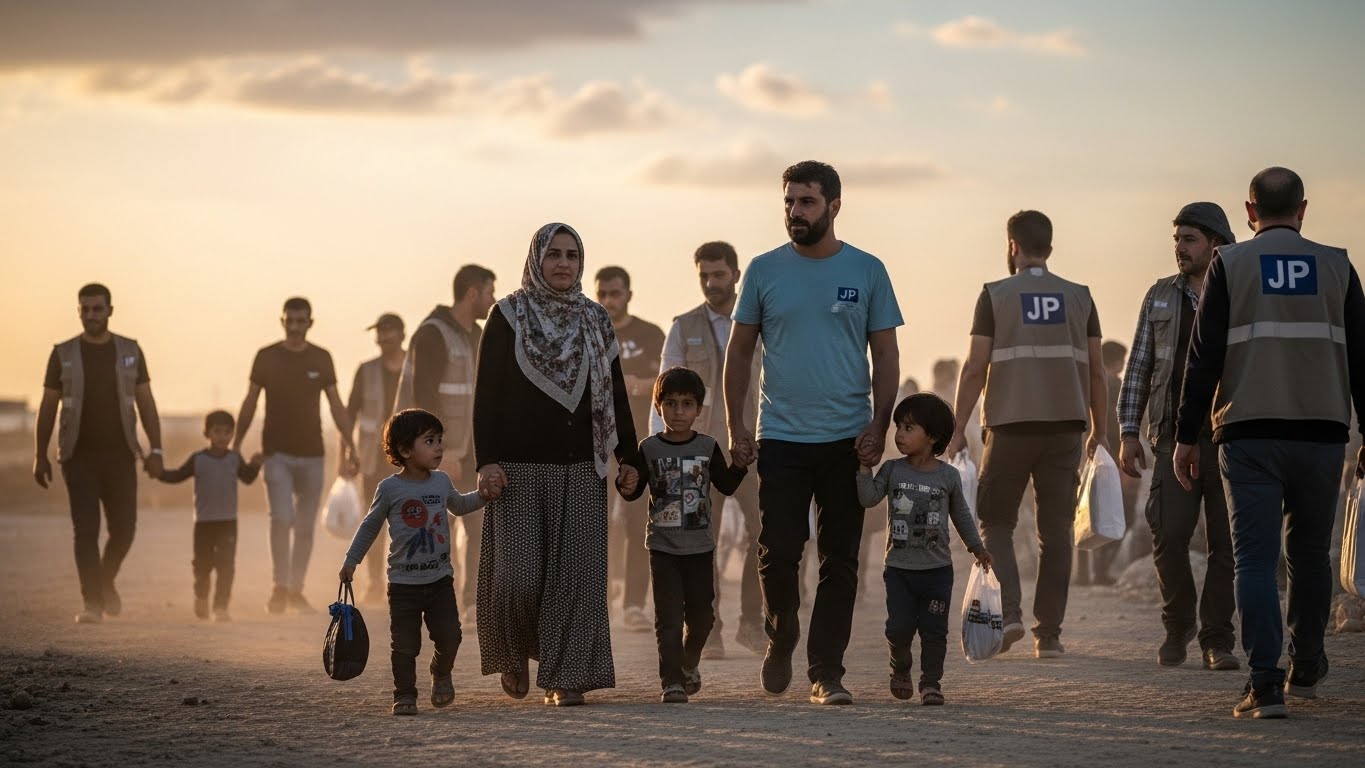
The year 2025 has brought the world to a critical point. More people than ever before are being forced to leave their homes because of fear, war, natural disasters, political instability and lack of safety. The global refugee crisis has reached its highest level in human history and the need for urgent help continues to increase.
This is not just a number or a statistic. It is a human story. It is about families, children, mothers, elderly people and young adults who lose everything in a moment and must search for safety in places they have never seen before.
In this detailed blog we will explore the reasons behind the rising global displacement, the situations unfolding in different regions, the impact on communities, and the important role of NGOs like JP Foundation in providing hope and support. In the end we will discuss why donations and volunteering are needed now more than ever.
Understanding the Global Rise in Displacement in 2025
Every year the number of refugees increases, but in 2025 the situation has become more complex. The world is facing multiple challenges at the same time and these challenges push millions of people into danger.
Growing Conflicts and Wars
There are many regions where conflicts have either intensified or newly started. When violence becomes part of daily life, families have no choice except to leave their homes. They walk for miles, cross borders and hope someone will give them shelter. This is happening in several countries across the Middle East, Africa and parts of Asia. Even when a conflict ends, it is not easy for people to return because their homes are destroyed and their communities are broken.
Natural Disasters and Climate Change
Floods, earthquakes, droughts and storms are becoming stronger every year. Climate change is pushing communities out of their homes because land becomes unsafe, farms cannot grow crops and entire villages lose access to clean water. Many families in Asia, especially in coastal areas, experience displacement because of heavy rainfall and rising sea levels. These families become environmental refugees who must leave not because of war but because nature no longer allows them to survive in the same place.
Political Instability and Unsafe Living Conditions
In several countries people live under strict rules, discrimination or constant threat from different groups. When the government or local systems fail to protect communities, they escape in search of safety. Sometimes families travel from country to country for years before they find a place where they can stay peacefully.
Economic Collapse and Poverty
While poverty alone does not always cause displacement, extreme economic collapse can turn daily life into a struggle for survival. When communities cannot access food, health care or income, they may be forced to migrate. This type of displacement is seen in many regions of Asia and Africa where people leave because they want to give their children a better future.
These combined factors explain why the world is witnessing a historic increase in refugees in 2025. The crisis is not caused by one event but by many forces happening at the same time.
Refugee Situations Across Asia, the Middle East and Beyond
The global refugee crisis has different faces in different regions. Each region has its own struggles but the suffering and the need remain the same everywhere.
Refugee Challenges in Asia
Asia hosts millions of refugees from multiple countries. These refugees often face problems like limited legal status, lack of documents, restricted movement and limited access to education and health care.
In countries like Thailand and Malaysia refugees often live without legal protection. Families depend on donations and community groups to survive because they cannot work freely. Many children have no access to school and families live in fear of being arrested or sent back to unsafe places.
In South Asia the situation is also difficult. Many refugee groups have lived for years in temporary locations with very few resources. They try to rebuild their lives but without support they continue to struggle.
Impact in the Middle East
The Middle East has some of the highest numbers of displaced people. Wars, political conflicts and economic difficulties have pushed millions into neighboring regions. These refugees often live in large camps or crowded cities where resources are limited. Access to medical care, clean water and stable shelter remains a daily challenge.
Refugees in Africa and Other Regions
Several African countries host refugees from neighboring regions affected by conflict. Many communities have shown great kindness by opening their homes and hearts, but the pressure is too high and resources are too few. Communities struggle to support both their own families and the incoming refugee population.
Around the world there are many stories like these. The common thread is the need for support. Refugees want safety, dignity and a chance to rebuild their lives.
How the Global Refugee Crisis Affects Communities
Refugees do not leave their homes by choice. They leave because survival becomes impossible. When they arrive in a new place, several challenges arise.
Pressure on Local Communities
Local communities want to help but they often have limited resources. Schools become crowded, hospitals struggle with more patients and housing becomes harder to find. Communities need support to manage this new reality.
Cultural and Social Challenges
Refugees come from different backgrounds and cultures. While diversity brings beauty, it can also create misunderstandings when there is no system to support new families. Language barriers make it hard for refugees to work, study or communicate.
Economic Impact
When refugees cannot work legally, they depend on aid. This increases pressure on local economies. However, when given opportunities, refugees can actually contribute positively, start businesses and support their families independently.
These challenges show why refugee support systems must be strong, organized and continuous.
The Critical Role of NGOs in Filling the Humanitarian Gap
Governments alone cannot handle the growing crisis. NGOs are essential in bridging the gap between need and resources. JP Foundation is one such organization focused on providing hope and practical support to refugees who often have nowhere else to turn.
Why NGOs Matter More Than Ever
NGOs provide direct help where it is needed the most. They offer shelter, education, food support, medical care and emotional guidance. They support families during the most difficult time of their lives. NGOs also advocate for refugee rights and create awareness about the reality of displacement.
How JP Foundation Makes a Difference
JP Foundation is committed to serving refugees with compassion and dignity. The foundation provides support for families in Thailand, Malaysia, Sri Lanka and Pakistan. This support includes education, resettlement guidance, food and shelter help, medical assistance and emotional care.
The foundation works closely with community groups, churches and other organizations to create a network of support. These partnerships ensure that refugees do not feel alone and are able to rebuild their lives with respect.
Serving with Hope and Humanity
At JP Foundation the belief is simple. Every life matters. Every family deserves dignity. Every child deserves hope. These values guide every program and every step taken to help refugees survive, grow and dream again.
Why Support and Volunteering Are More Important Than Ever
The global refugee crisis in 2025 is not slowing down. The need for humanitarian aid is growing every single day. This is why support from donors, volunteers and partners is more important now than ever before.
Why Your Support Makes a Real Difference
Your donation can help a child go to school. It can give a family a place to sleep. It can provide food to someone who has not eaten for days. It can help refugees in detention centers. It can save a life.
How Volunteers Create Change
Volunteers bring energy, kindness and time. They teach children, organize events, help in community programs and offer emotional support. Volunteers are the heartbeat of every successful humanitarian organization.
A Call to Action for Everyone
This crisis affects all of us because we are all part of one global family. No one should suffer alone. No one should live in fear. No one should lose hope.
JP Foundation welcomes supporters, volunteers and partners to join hands in creating a world where refugees can rebuild their lives with dignity and courage.
Conclusion
The global refugee crisis in 2025 shows us one clear truth. Humanity must stand together. The need is rising, the challenges are increasing, but hope is still alive. With compassion, support and collective effort we can give refugees a chance to live again with safety and dignity.
JP Foundation remains committed to this mission. Together we can bring real change and create a future where every displaced person is seen, supported and valued.